skip to main |
skip to sidebar
There are tortoises alive today that were 25 to 50 years old when Charles Darwin was born. There are whales swimming the oceans with 200-year-old ivory spear points embedded in their flesh. There are cold-water sponges that were filter-feeding during the days of the Roman Empire. In fact, there are a number of creatures with life spans that make the oldest living human seem like a spring chicken in comparison. Here’s our list of the 10 animals with the longest life spans.

The world’s latest high-jump champ just might live in your backyard.
10. Bharal
They live in Himalayan and one of the best jumpers among animals.
They’re adapted to jump from cliff to cliff and hill to hill.
9. Hare
They are one of fastest animals which have great ability to jump. They can run up to 45 mph or 72 km/hour, hard to get caught by predators.
8. Red Kangaroo
They are fastest jumper among all mammals. They can jump with speed up to 35 mph or 56 km/hour.
7. Klipspringer
Their height around 1,5 m., they can jump 10 times their own body
height. They are highest jumper among all mammals compared to body size.
6. Grasshopper
They can jump 20 times their own body length. Imagine a person who can jump as long as basketball court.
5. Kangaroo Rat
They can 45 times their own body length. Imagine a person who can jump
over a football court. They are longest jumper among all mammals
compared to body size.
4. Froghopper
They can jump 70 times their own body height. They’re the 2nd highest jumper among animals compared to body size.
3. Jumping Spider
They can jump 100 times their own body length. Imagine a person who can jump as long as 2 jumbo jets.
2. Tree Frog
They can jump 150 times their own body length. Imagine a person who can
jump as long as RMS Titanic. They are 2nd longest jumper among animals
compared to body size.
1. Flea
They can jump 220 times their own body length and 150 times their own body height. They are longest and highest jumper among animals compared to body size.
Source
This mouse danced with death when it tucked itself into the lunch of a hungry leopard. Like a little child and seemingly unaware of the beast towering over it, the mischievous rodent grabbed at scraps of meat thrown into the African Leopard's enclosure. But instead of pouncing on the tiny intruder, the 12-year-old leopard, called Sheena, appeared to be afraid of the daring mouse and kept her distance. At one stage she tried to nudge the mouse away with her nose, but the determined little guy carried on chewing away until he was full.

We all know chameleons, especially for some of their performances, like
the ability of changing color or for their special hunting technique.
While the ability of changing color is not so singular in the animal world (many fishes, cephalopods like octopuses and squids, or even other lizards have it), their technique of projecting an enormously long sticky tongue is regarded by many as very specific.
That's wrong, as exactly the same method of catching prey is employed by a group of salamanders from the Americas.
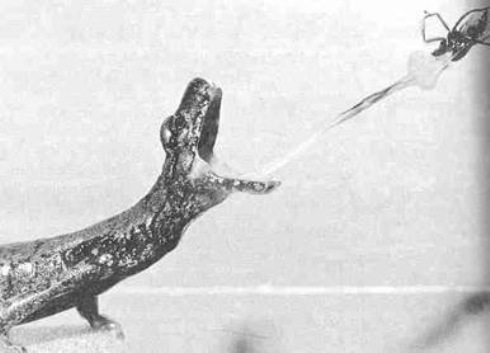
Moreover, a new research at University of South Florida found an unusual record for these animals: the giant palm salamander of Central America shoots out its tongue with the fastest speed developed by any known muscle in the animal world.
The species, Bolitoglossa dofleini, can shoot out its tongue at 18,000 watts of power per muscular kilogram, about twice more than the power output broken out by the previous record detainer, the Colorado River toad Bufo alvarius.
Bolitoglossa
extends its tongue (which measures more than half of its body length)
in about 7 milliseconds, 50 times faster than an eye blink. The research
team employed high-speed video cameras and electrodes implanted in the
salamanders' tongue muscles to check the animals' performances as they
hunted live crickets.
The fact that the tongues were propelled outward much faster than by
sheer muscle contraction made the researchers suppose there must be an
unknown elastic tissue connected to the salamander's tongue that stores
up the energy amounts required by the explosive projection.
The process can be compared to the stretching and shooting of a rubber band: the recoil occurs faster than the act of releasing a rubber band pulled taut. "The amount of energy doesn't change; it's just released faster," said lead researcher Stephen Deban.
Tongue-launching systems found in other species is formed by three components: a motor to produce energy, a spring to store it and a latch to control the unloading of the spring, but by now only the motor in the salamander system has been found. "What remains to be discovered are the anatomical structures that make up the spring and the latch" said Deban.
Source

In this blog you can find all the world animals, Aw Inspiring Pictures of Cute Animals, Most Smartest Dogs, Most Famous Dog Breeds, Ugliest Animals on Earth, Bizarre Miniature Animals, Most Interesting Moments in the Animal World and more. We keep you well informed about what is happening in the world animals. This blog always will be renewed.
10 Animals With the Longest Life Spans
/
Comments: (0)
There are tortoises alive today that were 25 to 50 years old when Charles Darwin was born. There are whales swimming the oceans with 200-year-old ivory spear points embedded in their flesh. There are cold-water sponges that were filter-feeding during the days of the Roman Empire. In fact, there are a number of creatures with life spans that make the oldest living human seem like a spring chicken in comparison. Here’s our list of the 10 animals with the longest life spans.
Geoducks
Top 10 Best Jumper Animals in the World
/
Comments: (0)
The world’s latest high-jump champ just might live in your backyard.
10. Bharal
9. Hare
8. Red Kangaroo
7. Klipspringer
6. Grasshopper
5. Kangaroo Rat
4. Froghopper
3. Jumping Spider
2. Tree Frog
1. Flea
They can jump 220 times their own body length and 150 times their own body height. They are longest and highest jumper among animals compared to body size.
Source
The World's Bravest Mouse
/
Comments: (0)
This mouse danced with death when it tucked itself into the lunch of a hungry leopard. Like a little child and seemingly unaware of the beast towering over it, the mischievous rodent grabbed at scraps of meat thrown into the African Leopard's enclosure. But instead of pouncing on the tiny intruder, the 12-year-old leopard, called Sheena, appeared to be afraid of the daring mouse and kept her distance. At one stage she tried to nudge the mouse away with her nose, but the determined little guy carried on chewing away until he was full.
World's Fastest Muscle (In the tongue of a salamander)
/
Comments: (0)
While the ability of changing color is not so singular in the animal world (many fishes, cephalopods like octopuses and squids, or even other lizards have it), their technique of projecting an enormously long sticky tongue is regarded by many as very specific.
That's wrong, as exactly the same method of catching prey is employed by a group of salamanders from the Americas.
Moreover, a new research at University of South Florida found an unusual record for these animals: the giant palm salamander of Central America shoots out its tongue with the fastest speed developed by any known muscle in the animal world.
The species, Bolitoglossa dofleini, can shoot out its tongue at 18,000 watts of power per muscular kilogram, about twice more than the power output broken out by the previous record detainer, the Colorado River toad Bufo alvarius.
The process can be compared to the stretching and shooting of a rubber band: the recoil occurs faster than the act of releasing a rubber band pulled taut. "The amount of energy doesn't change; it's just released faster," said lead researcher Stephen Deban.
Tongue-launching systems found in other species is formed by three components: a motor to produce energy, a spring to store it and a latch to control the unloading of the spring, but by now only the motor in the salamander system has been found. "What remains to be discovered are the anatomical structures that make up the spring and the latch" said Deban.
Source
Popular Posts
-
If there are any large dogs that are well known in the world, Zorba is probably one of them. Zorba is an English Mastiff from the UK that ...
-
Bugs tend to freak us out. Mosquitoes, spiders, wasps, centipedes... you name it. If it crawls, bites or buzzes (especially anywhere ne...
-
During a research cruise in the North Atlantic Ocean, scientists aboard the British vessel James Cook cataloged a menagerie of marine org...
-
Who doesn’t like monkeys? Sometimes weirdos, irritating but always entertaining. Jill Greenberg took one step further and made some photos...
-
Funny lamas with haircuts . Animals are a major group of multicellular, eukaryotic organisms of the kingdom Animalia or Meta...
Blog Archive
Followers
Powered by Blogger.
You can replace this text by going to "Layout" and then "Page Elements" section. Edit " About "